


Situation: What is Edutainment? What is Efficacy?
“Edutainment” traditionally has meant media designed to educate through entertainment. The term has been in use at least since 1954 by Walt Disney. In practice, edutainment has been a dirty word among educators because it was associated with subpar pedagogy and poor learning outcomes. The prevailing belief was that entertaining content encouraged passive absorption rather than active learning. Nevertheless, the promise of ‘edutainment’ was to solve the motivation and incentive layer for learner engagement. Entertainment is fun! You want to do it.
“Efficacy” refers to the ability of a product to produce the desired result or effects. This refers to the strong and growing emphasis on educational outcomes over the past decade. Access to government funding now requires standards of efficacy. While tests and textbooks represent a small portion of the money spent on education globally, the money spent on teaching, learning, and related services is a larger and faster-growing share.
Put together, what do we mean?
Efficacious Edutainment is an emerging consumer category of learning products using best-in-class technology to help people learn skills, knowledge, and values. Technological and cultural change have combined these concepts into a powerful synergy with immense potential to educate the next generation and establish a massive new industry.
Learning, while never easy, doesn’t need to feel impossibly hard and dull.

Gen Z and Gen Alpha are the first generations born into a world that is interconnected through devices. They have a gateway to limitless information. Visual graphics, videos, and engrossing games are a few swipes away. Unsurprisingly, the youngest among us have taken to technology as second nature.
Of course, not all of that time spent online is enriching. Straight consumption of empty content does little to build human potential and empowerment. Worse yet, bad actors can utilize platforms to create dark patterns, employ clickbait, and engage in abuse.
However, magic can happen when companies dedicate themselves to setting learning goals and designing for learning. We will focus on the massive opportunity — and avalanche — that results when technology and pedagogy work together.
Digital media has transformed the possibilities of education along four dimensions: We call it GIST.
Gamification: Application of incentives and storytelling (e.g., gaming).
Immersiveness (e.g., multimedia including AR/VR, personalized generative AI content).
Social Collaboration (e.g., multi-player).
Timeliness (e.g., on-the-go, spot training, micro-courses).
Companies selling learning outcomes and education enrichment need to leverage these four dimensions to design products for the next era of learners. Parents and educators are paying attention. They know they will need new tools to engage and motivate the next generation to learn. The school most critical to the future of education may well be the school of edutainment.
Why is now an inflection point?
First, the kids are already there.
The gap between the stagnant status quo in classrooms and the promise of an immersive future has never been greater. Children spend seven hours a day on social media, and the trend continues to grow when gaming is factored in. Over half of US kids are playing Roblox. It is challenging to make a case for reversing the interest in gaming. New research from Pew shows that one-in-five teens visit YouTube and TikTok ‘almost constantly.’
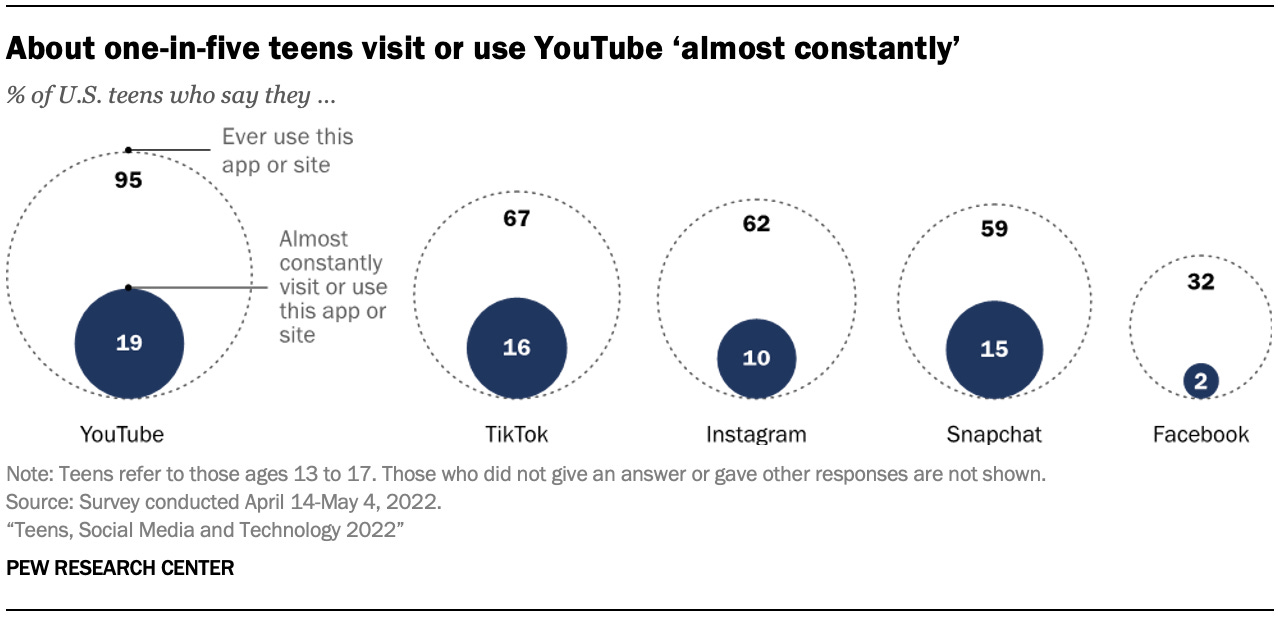
Big media companies have seen the opportunity. #LearnOnTikTok has over 403 billion views. YouTube announced its Player for Education with two priorities that anticipate the future. They now have a distraction-free player for curated content. They added an authoring tool for creators to make courses. Netflix is acquiring gaming studios and shifting its media strategy toward gaming. While they haven't explicitly focused on learning content, the emphasis on gamification is clear.
Second, the development costs of edutainment products are competitive - it is now cheaper than ever to develop games and immersive experiences.
Unity and Epic’s Unreal Engine have made game development much cheaper. This lowers the barriers to entry for new content creators hoping to tackle learning use cases. Additionally, the hardware is becoming increasingly affordable. Additionally, as mainstream gaming becomes more competitive, the industry is seeking niches, and education is a prime target, given the substantial dollars at stake. Success in game adoption has always been driven by strong product-market fit.
Third, evidence shows that when edutainment works, it really works!
Efficacy is now the name of the game in education. Parents want it, and learning institutions demand it. Research on the ability of edutainment to drive learning outcomes is ongoing and increasing. Overall, research has found a solid basis for the belief that each GIST element can drive learning outcomes when well executed. Evidence in support of driving learner engagement with immersive learning through augmented and virtual reality is particularly high.
Of course, each edutainment product must prove its efficacy through increasingly rigorous and ongoing measurement. Many products will claim to teach and educate. But whether actual learning occurs is an entirely different matter.

Fourth, consumers are taking their learning into their own hands — and there are increased funding mechanisms for educators and parents to control how they spend.
Parents realize they must spend out of pocket to invest in their child’s education. Parents will choose to pay for edutainment products that offer more learning enrichment rather than empty game play. Additionally, more government funding is being allocated to individual decision-makers, who are increasingly personalizing education for students through mechanisms such as Education Savings Accounts (ESAs) and Individualized Education Programs (IEPs). Expect these programs to focus on efficacy, outcomes, and adherence to learning standards, as the Every Student Succeeds Act (ESSA) requires federal funds to be used for interventions in K-12 that meet one of four documented levels of evidence.
What startups and companies are building efficacious edutainment?
Below is a sampling of organizations and companies pushing the boundaries on edutainment. Many of these products spike on more than one dimension of GIST. We’ve highlighted the category where a particular product shines most. While many of the examples highlighted are from the traditional education sector, we believe efficacious edutainment spans the entire pre-k to 100 spectrum, including post-secondary education and alternative credentialing and skills.
A notable example of a sizable and efficacious edutainment company is Duolingo, which has established a brand in timely, gamified language learning. Many early startups take inspiration from the Duolingo playbook and want to copy it.
Gamification: Applications of incentives and storytelling.
Gaming is now the largest media category by spend and is bigger than all the other categories combined. It’s no surprise that gaming and education will form a powerful partnership. Elements of games, such as points and incentives, are powerful motivational factors in completing tasks and staying engaged.
The Social Institute founder, Laura Tierney, was a four-time all-American athlete at Duke University and found that adults would harp on the Don’ts of social media usage: Don’t text this, don’t share that, don’t join that app, and don’t post anything you wouldn’t want your grandmother to see. Laura flipped the script and launched the #WinAtSocial, a best-in-class social-emotional curriculum gamified for success.
Other notable models lean into gaming explicitly, including Legends of Learning, with curriculum-aligned math and science games.
Immersiveness
The core concept is about simulating complex real-life situations using role-playing, exploration, and narrative storytelling. This is taken to an even higher level with AR/VR in the proverbial ‘metaverse.’
“VR’s most powerful use case has always been education because of its ability to realize best practice teaching methods.”
— Anurupa Ganguly, Founder, and CEO of Prisms, a curriculum for learning math using spatial reasoning.
In this category, Creatium’s AI-enabled product transforms the traditional textbook into a rich multimedia experience that truly engages learners and empowers teachers.
Social Collaboration
Humans are social creatures and enjoy interacting with one another through play. In-person learning has often used a group work component. Technology now enables instant and seamless social collaboration online. For example, Sparkwise designed its multi-player approach to skill building to give teams an exciting way to learn and grow together through group challenges.

“Kids have always learned together in physical spaces and, in coming years, they’ll start learning in virtual spaces, too.” - Class Dojo
Escape rooms, hacking leagues, and online clubs like Synthesis also use social collaboration through software design as a critical learning tool.
Timeliness
Just-in-time learning for new skills and discrete tasks like homework completion. Technology allows learners to get education and learning products on demand whenever, wherever. There is an opportunity for targeted businesses that use the user experience design of big platforms like TikTok with curated content and additional learning design elements to solve a specific learning use case.
Risks to the Vision of Efficacious Edutainment:
The prospect of entertaining, effective learning that won’t feel like work is immensely compelling. Nevertheless, the devil is in the details – in this case, of business models, investment, regulations, product development, and management team priorities. Risks we have been watching for include:
Regulatory confusion and scrutiny for online gaming. A series of existing statutes and regulations, including The Children's Online Privacy Protection Act (COPPA), have been established as guardrails for the online gaming industry. These need to be reckoned with as gaming companies enter the learning sector. The FTC recently fined Epic Games $520M to settle a case involving children’s privacy and shopping. Complying with these regulations may slow fast-moving innovation and increase costs.
Consumers continue to lack mastery of the basics, like literacy. It is estimated that 53% of Americans read below a 6th-grade reading level. Learning through immersive reality can be powerful for building knowledge and discrete skills. But there is no substitute for the basics of literacy, numeracy, and writing, which may require traditional methods with unique interventions.
Media and gaming are traditionally hit-driven business models. Gaming, consumer social, and media businesses are hit-driven businesses subject to the power law. The winners compensate for the long tail of projects that fizzle out and lose money. Efficacious edutainment products are rarely viral hits. The sales process is complex and requires the activation of parent and educator choices. However, there are indicators that product-led growth can be successful in education settings, as demonstrated by players like Mystery Science.
High-quality curation is needed to weed out poor-quality content. Curation will be critical as user-generated content proliferates due to decreasing production costs. Sequencing modules, levels, and assessments are essential elements of learning design. The quality of learning design is the key determinant for outcomes. More is not always better, and there will be a lot of inefficacious edutainment.
The magnitude of parents’ willingness to pay for more education-oriented content is still unclear and yet critical for direct-to-consumer business models. Most American parents are unwilling to pay high monthly subscriptions for education products, with some exceptions among top-income earners and specific minority segments.
Could incumbents compete? Perhaps. Would they make it a priority? Probably not.
YouTube has already made significant strides in education. Media houses like Disney, Meta, Amazon, and Netflix are entering the learning segment. We expect that the big tech behavior of the past will persist. The education use case is unlikely to be a top-five priority for big companies because the market size is considered smaller and more difficult to access. It’s more likely that big tech companies would buy content a la carte rather than develop in-house. There is a significant opportunity for collaboration between new learning startups and the larger technology platforms. Meta Quest needs high-quality content to sell devices and drive adoption, but Meta is not likely to want to make this content in-house.
What about significant publishers like Pearson, McGraw Hill, and Wiley? The leadership teams of these legacy publishers are keenly aware of their need to adapt. Pearson has recently appointed Andy Bird as their new CEO, showing a more significant direct-to-consumer mandate. Publishers will need to attract and incentivize talent to produce new products. They will likely struggle internally from innovators’ dilemma. Additionally, these players have traditionally acquired innovation when necessary and have a history of making strategic acquisitions. Competing publishers provide an exit opportunity for successful innovators who require larger platforms or greater capital to scale than venture markets provide.
Conclusion: Those who blend pedagogy with new technology that captures learners into flow will thrive.
We are optimistic that a few powerhouse edutainment companies will emerge in the next decade. They will combine the best of technology tools and learning design to create personalized content experiences. These will start as small and experimental.
One thing is for sure: dinosaurs are going to die. There is no room in the future for stale textbooks and unimaginative curricula. The distribution potential of the internet allows for exponential growth for exceptional products. Will the next big learning company be direct-to-consumer? It’s certainly possible.
We are excited to discuss and partner with visionary teams building the future of efficacious edutainment.
Disclosure: Avalanche is an investor in Prisms of Reality, Creatium, Sparkwise, Recess, Codedex, and The Social Institute.
Further reading
Vision from Bitkraft VC
The Promise of Immersive Learning: Augmented and Virtual Reality’s Potential in Education
Gaming Industry Nearly Twice as Large as Reported, at $336B. Here.
Immersive Experiences in Education: New Places and Spaces for Learning by Microsoft
Interesting read and summary for someone looking at the landscape from outside the space. As a parent of young children, I wonder how we can create the right incentives for edutainment companies. Success in entertainment/media is eyeballs and time spent with content. I'd argue that would be the incorrect measure of success here. In fact, more learning in less time would seemingly be the goal.
How can we incentivize innovation (and let's be honest, monetization) around learning outcomes? A product that can measure my children's progress is a product that will get my dollars.
Thank you for this detailed analysis Katelyn. Most of the elements might be true for all countries and not just the US.
Would the assumption be correct that the analysis is more geared towards K12 school districts in the US and hence discusses the structured learning pathways there?
I think you might agree that edutainment might be equally if not more important for learning skills such as financial literacy, life skills, skills in general, assessments of skills including things such as driving skills.
Akhil Kishore
Partner - GIA ADVISORS